
Understanding the Buzz Off Miss Pill rule solves a common question early readers ask: why is the word “shell” spelled with two Ls, while the word “pig” ends with just one G?
To an elementary student navigating language-based learning differences, English spelling often feels like a collection of arbitrary traps. Words appear to follow clear patterns until suddenly they do not, leaving developing readers to rely on memorization or wild visual guessing. When spelling homework turns into tears and frustration, parents frequently recognize the subtle signs a child is struggling to read long before standard report cards arrive.
In structured literacy and Orton-Gillingham instruction, we do not ask children to memorize letter strings by rote. We teach them reliable phonetic principles. One of the most engaging, memorable tools a child can learn to tame double consonants is the Buzz Off Miss Pill rule.
What Is the Buzz Off Miss Pill Rule?
The Buzz Off Miss Pill rule (traditionally known in phonics programs as the FLOSS rule) teaches children precisely when a base word requires a doubled final consonant.
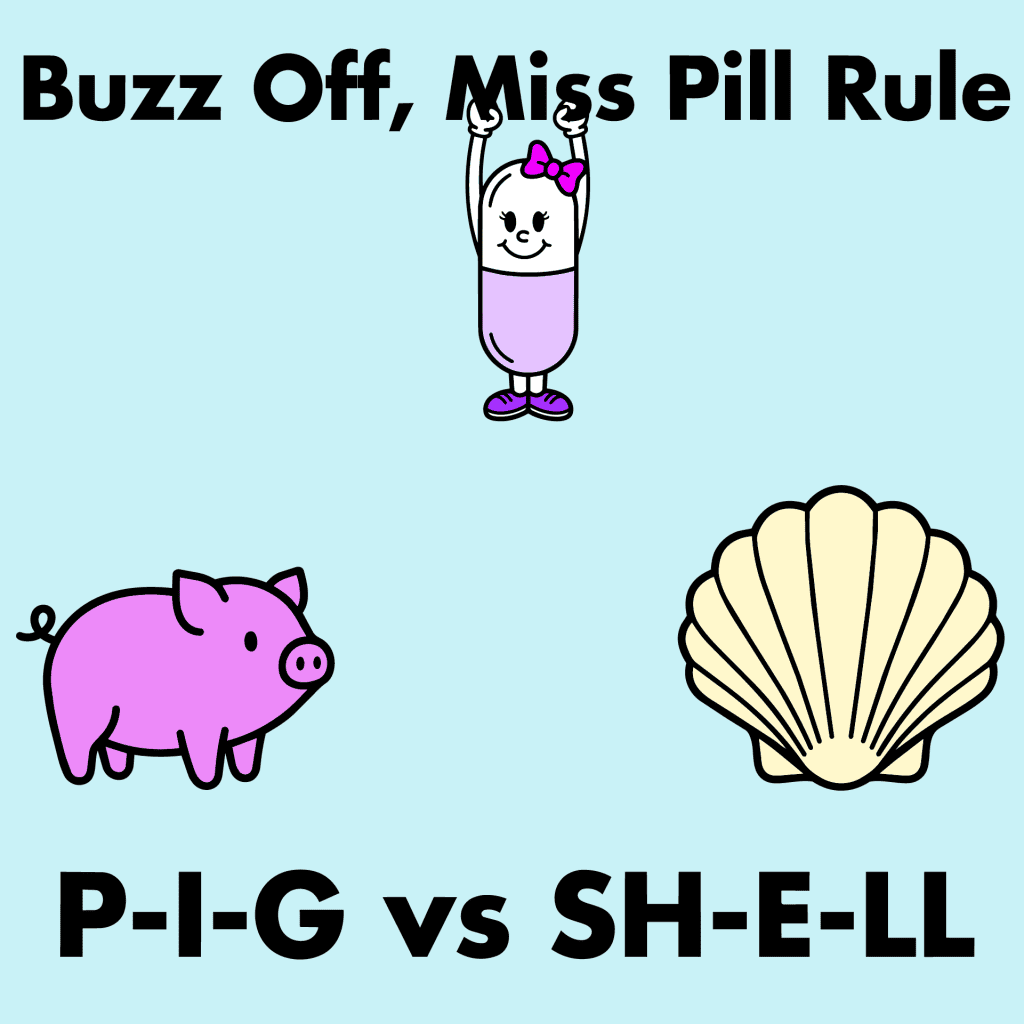
What makes this mnemonic so powerful for young learners is that every single word in the phrase demonstrates the rule in action:
- Buzz → doubles the letter Z (buzz, fizz, jazz)
- Off → doubles the letter F (cliff, sniff, puff, stuff, stiff)
- Miss → doubles the letter S (grass, mess, kiss, moss, dress)
- Pill → doubles the letter L (shell, hill, bell, tell, doll)
A word doubles its final consonant when it meets three specific criteria:
- It is one syllable.
- It contains a single short vowel sound (like the short /u/ in buzz, short /o/ in off, short /i/ in miss, or short /e/ in shell).
- It ends immediately with the sound of /z/, /f/, /s/, or /l/.
When all three conditions check out, the final letter is doubled automatically.
Why “Pig” Has One G and “Shell” Has Two L’s
Children frequently ask why consonants like g, t, or d do not double at the end of short words. Words like pig, cat, bed, and cup end in single letters because English spelling rules reserve this specific short-vowel doubling pattern for the target letters in “Buzz Off, Miss Pill” (Z, F, S, and L).
Understanding this structural boundary gives children instant confidence in their writing. Instead of guessing between shel or shell, they run through their mental checklist: One syllable? Yes. Short vowel? Yes. Ends in the ‘Pill’ sound (/l/)? Yes, double the L.
How to Handle the Exceptions (Without Guessing)
Every parent knows English has its quirks, but in an Orton-Gillingham framework, exceptions are not treated as random mysteries. We teach the rule-breakers explicitly so children never feel blindsided.
1. Everyday Sight Words
A small collection of high-frequency words do not follow the Buzz Off Miss Pill rule:
- gas, bus, yes, us, if, and chef
Because these are short, everyday words children encounter early in primary readers, we teach them as predictable sight-word exceptions rather than letting students guess.
2. The Secret /z/ Sound in “Was” and “His”
Children often wonder why words like is, his, has, and was do not end in a double S.
The reason comes down to phonology: in these words, the letter S does not make its unvoiced hissing sound (/s/). It makes the voiced buzzing sound (/z/). Because the word does not end in a true /s/ phoneme, the rule does not apply. Revealing this single detail prevents endless spelling confusion.
3 Multisensory Ways to Practice the Rule at Home
According to structured literacy research shared by Dyslexia Canada, multisensory reinforcement helps struggling readers permanently map spelling rules into long-term memory:
- Act Out the Character: Introduce “Miss Pill” as a funny classroom character. Whenever your child writes a target word, have them say: “Buzz off, Miss Pill. This one needs a double!”
- Finger-Tapping Sounds: Have your child tap out the speech sounds on their fingers before writing (sh-e-ll = 3 sounds, 4 letters). This reinforces that the doubled consonants work together to represent a single sound.
- Sensory Tray Tracing: Have your learner trace double-letter endings in a tray of colored sand or shaving cream while reciting the phonetic cue: “Short vowel before Z, F, S, or L gets doubled.”
Applying the Buzz Off Miss Pill rule through multisensory practice turns abstract spelling lists into a concrete, predictable system.
Frequently Asked Questions
Is the Buzz Off Miss Pill rule the same as the FLOSS rule?
Yes. Both mnemonics teach the exact same Orton-Gillingham doubling rule for final F, L, S, and Z. Many educators prefer “Buzz Off, Miss Pill” because every single word in the sentence models the doubled spelling rule, making it easier for younger students to remember.
When should a child learn the Buzz Off Miss Pill rule?
This rule is introduced in late Kindergarten or Grade 1, as soon as a student has mastered three-letter CVC words (like cat, hop, and run) and understands how short vowel sounds behave.
Unlock Confident Reading and Spelling
When children understand the mechanics behind English words, reading anxiety transforms into curiosity and confidence. At Areté Orton-Gillingham Studio, we provide personalized, one-on-one structured literacy tutoring designed to help students with dyslexia and reading delays master decoding from the ground up.
Schedule an Initial Consultation at Areté OG Studio to explore in-person tutoring in Langley, Vancouver, and Maple Ridge, BC, or flexible online instruction across Canada.